In this guide
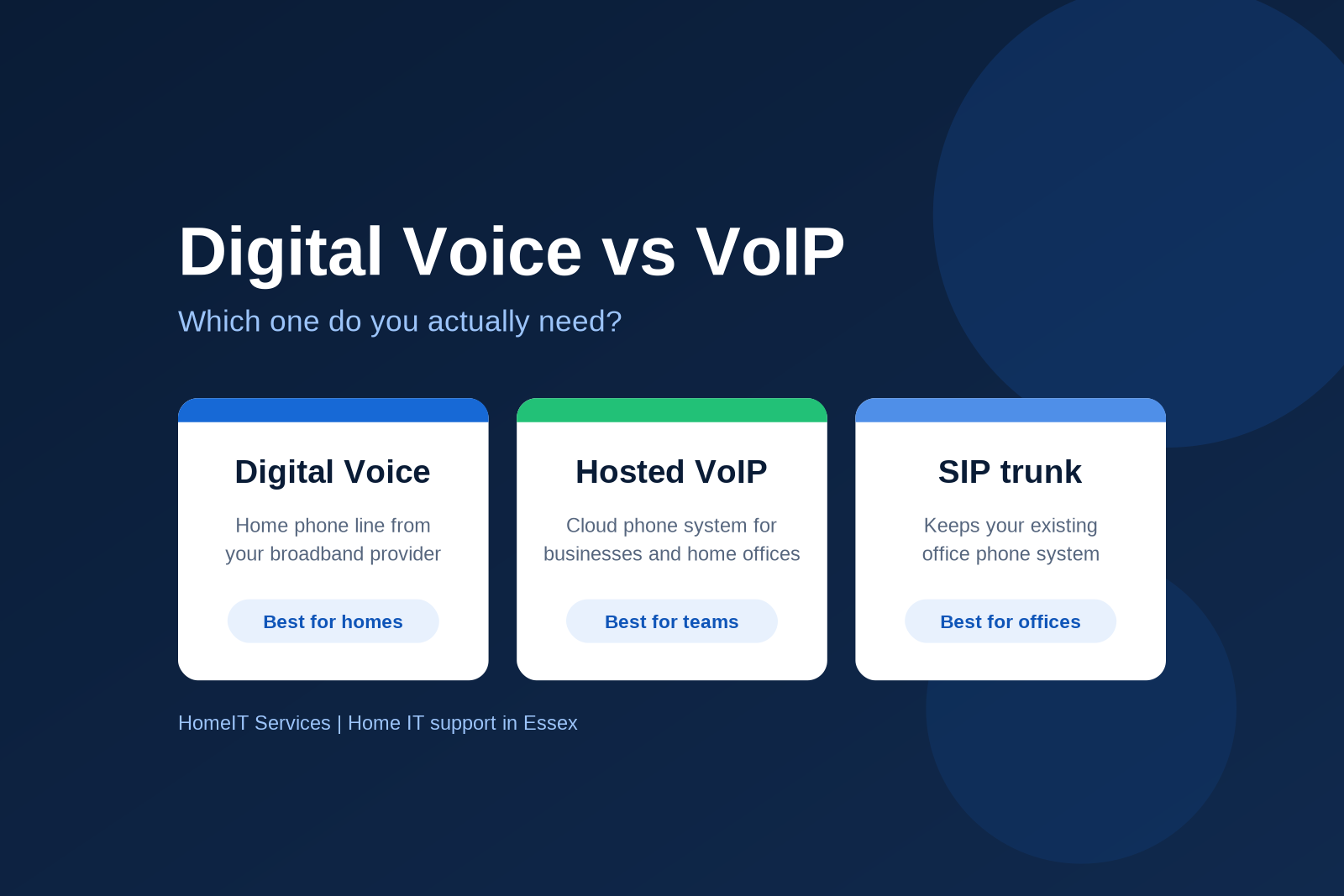
Short answer: Digital Voice is the home phone service your broadband provider gives you to replace the old landline. VoIP is the wider technology behind it, and "hosted VoIP" is a business phone system in the cloud. For a home that just wants to keep a landline, Digital Voice is usually enough. For a business with several staff, hosted VoIP gives you far more control.
With the UK landline network being retired, providers are moving customers to phones that work over the internet. The names get confusing: Digital Voice, VoIP, hosted VoIP, SIP trunk. They all use the internet, but they are not the same product. Here is the difference in plain English, and how to choose.
VoIP: the technology behind them all
VoIP stands for voice over IP. It simply means phone calls travel as internet data instead of over the old copper phone network. Digital Voice, hosted VoIP and SIP trunks are all VoIP in different forms. If you want the full background, read what VoIP is and how it works.
Digital Voice: a landline replacement for homes
Digital Voice is the name several UK providers use for their home phone service delivered over broadband. You usually plug an ordinary phone into the back of your router, and you can often keep your existing number. It is designed to feel like a landline, with few extras.
- Simple, with little to set up.
- Provided and managed by your broadband company.
- Needs mains power and a working internet connection.
Hosted VoIP: a cloud phone system for businesses
Hosted VoIP is a full business phone system that lives with the provider, not in a cupboard in your office. Staff can answer on a desk phone, a laptop or a mobile app, and you manage everything online.
- Ring groups, so one call rings several people.
- Auto-attendant: "press 1 for sales".
- Voicemail to email, call recording and opening-hours routing.
- Easy to add or remove users as the team changes.
For costs and features, see our guide to VoIP phone systems for UK small businesses.
SIP trunk: keep your existing phone system
A SIP trunk replaces the physical phone lines going into an existing office phone system (a PBX) with internet-based ones. It suits a business that likes its current system and handsets and just needs a way to keep working after the landline switch-off.
Side by side
| Digital Voice | Hosted VoIP | SIP trunk | |
|---|---|---|---|
| Best for | Homes that want a landline | Businesses and home offices | Offices with an existing phone system |
| Who provides it | Your broadband provider | A VoIP provider | A SIP provider |
| Equipment | A phone plugged into the router | Desk phones, apps or headsets | Your existing phone system |
| Extra features | Few | Many | Depends on your system |
| Keeps your number | Usually | Usually, via number porting | Usually, via number porting |
How to choose in four questions
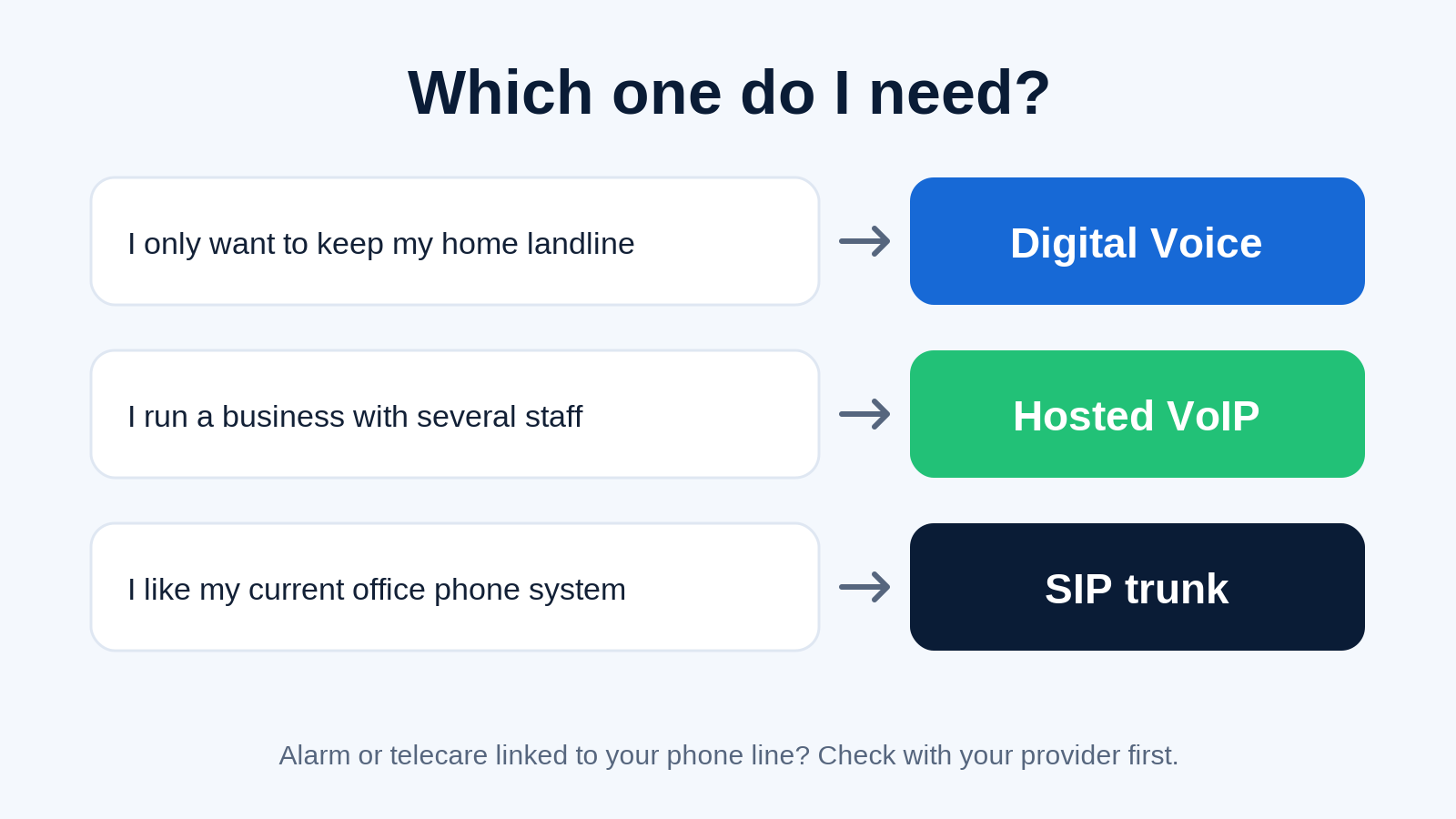
- Is it for a home or a business? A home that only wants a basic landline can usually stay with Digital Voice.
- How many people take calls? Several staff, call groups or remote workers point towards hosted VoIP.
- Do you already own a phone system you like? If so, a SIP trunk may be simplest.
- Is anything connected to your phone line? Burglar alarms, telecare pendants and card machines may use it. Check before you switch. Our guide on alarms and telecare after the switch-off explains what to ask.
Keeping your number
In most cases you can keep your existing number when you move to a digital service, through a process called porting. Confirm it with the provider before cancelling your old line. See whether you can keep your landline number.
Common mistakes
- Cancelling the old line before the new service is working.
- Forgetting about alarms, telecare and card machines on the same line.
- Relying on WiFi for desk phones instead of a cable.
- Not planning for a power cut. VoIP needs the router to be powered, so ask your provider about a battery backup or a mobile fallback.
If calls crackle or drop after switching, the network is usually the cause. See VoIP call quality problems and fixes, and the timing guidance in UK landline switch-off 2027: what to do.
Need help choosing or setting it up?
HomeIT Services helps Essex homes and small businesses move to digital phone services, from choosing the right option to preparing the network so calls sound right from day one. See our VoIP phone system service and network and VoIP installation, or get in touch for a clear recommendation and a fixed quote before any work begins.
HomeIT Services covers Southend-on-Sea, Chelmsford, Rayleigh, Billericay, Brentwood and Chigwell. See all the areas we cover.
Frequently asked questions
VoIP is the general technology of making calls over the internet. Digital Voice is one provider's home phone service built on it, designed to replace a landline. Hosted VoIP is a fuller business phone system, also built on VoIP.
Most homes do not need a business VoIP system. If you only want to keep a landline, the Digital Voice or similar service from your broadband provider is usually enough.
In most cases yes, through number porting. Confirm this with the provider before you cancel your old line.
It needs your router to be powered, so it will not work in a power cut unless you have a battery backup or a mobile fallback. Ask your provider what they offer, especially if you rely on the line for safety.
A SIP trunk replaces the physical phone lines going into an existing office phone system with internet-based ones, so the business can keep its current system after the landline switch-off.
Rather have it done properly?
Get a clear, fixed quote from a local engineer before any work starts.