

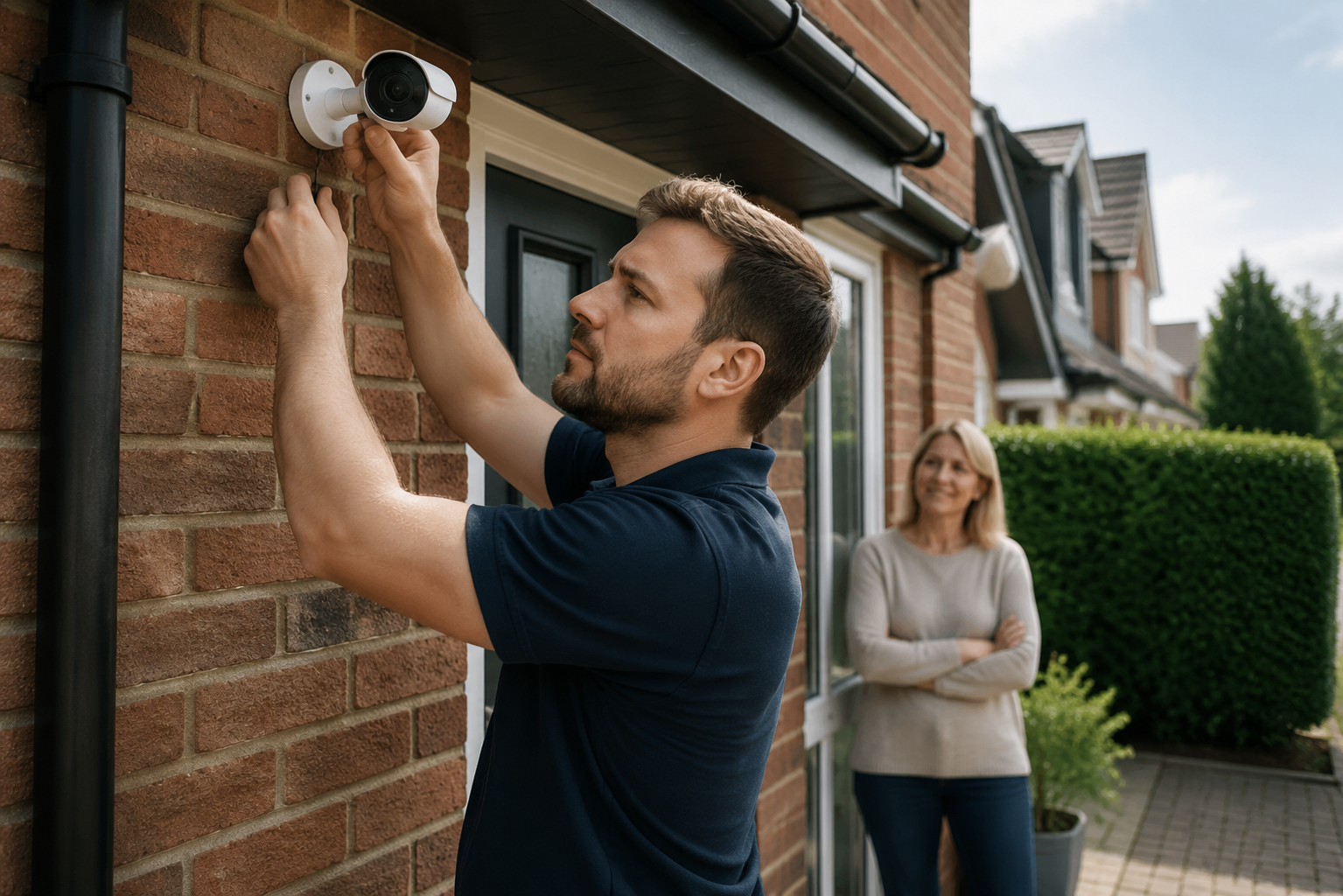
Home CCTV installation is one of the most common upgrades Essex homeowners make when they want real peace of mind about their property. Maybe a parcel went missing from the porch. Maybe a neighbour mentioned a break-in nearby. Whatever brought you here, this guide covers everything you need before installing CCTV at home.
We’ll walk through what’s actually involved in home CCTV installation, what it costs in 2026, whether DIY is worth it, what UK law says, and how to pick a system that still works properly in five years, not just five months.
What Does Home CCTV Installation Involve?
Home CCTV installation is more than mounting a camera and plugging it in. A proper domestic system has several parts that all need to work together.
The cameras
Most modern home CCTV systems use IP (network) cameras rather than older analogue ones. IP cameras send digital footage over your network. This usually means sharper video, better night vision, and the option to check your phone from anywhere. Analogue systems are cheaper but capped at lower resolution
The recorder and storage
Footage needs somewhere to live. That’s either an NVR (Network Video Recorder) in your home, a cloud subscription, or both. Local storage means you own the footage with no ongoing fee. Cloud storage protects your footage if the hardware itself is stolen.
The network
This is the part most DIY installs get wrong. Every wireless camera depends on a strong, stable WiFi signal. A camera with full bars sitting near a weak router still won’t record reliably. For larger homes, running proper cabling to fixed camera positions gives a far more dependable result than relying on WiFi alone. We cover this in more detail in our guide to home network setup and structured cabling across Essex homes.
The app and integration
Nearly all systems connect to a smartphone app. Many now connect to smart home platforms like Google Home, Amazon Alexa, or Apple HomeKit too, so your cameras work alongside your smart doorbell and lighting rather than sitting on their own.
Home CCTV Installation Cost in Essex (2026 Price Guide)
This is usually the first question homeowners want answered. Here’s a realistic breakdown of home CCTV installation cost in 2026.
| System type | What’s included | Typical cost |
|---|---|---|
| Basic DIY wireless kit (2-4 cameras) | Self-install, wireless cameras, app-based cloud storage | £150 – £400 |
| Mid-range wired system, professionally installed | 4 cameras, local NVR storage, professional cabling | £600 – £1,200 |
| Full smart-integrated system | 6-8 cameras, local and cloud backup, smart home integration | £1,200 – £2,500+ |
| Ongoing cloud storage subscription | Continuous recording, longer retention | £5 – £15/month |
A few things move the price. The number of cameras. Whether cabling needs to run through walls or lofts. Camera resolution, since 4K costs more to install and store than 1080p. And whether you want ongoing monitoring on top of recording.
If you’re comparing quotes, ask exactly what’s included. Labour, cabling materials, app setup, and a demonstration should all be part of a proper home CCTV installation service, not just the hardware itself.
DIY vs Professional Home CCTV Installation
DIY kits have genuinely improved. For a small flat or a single entry point, a self-install wireless camera can work well. For whole-property coverage, though, this is where most problems start.
Poor camera placement
Cameras get mounted at the wrong height or angle. This creates blind spots at exactly the points, like side gates or low windows, that matter most.
WiFi that can’t handle it
Several 4K cameras streaming at once puts real strain on a home network. If your WiFi already struggles in parts of the house, adding cameras usually exposes that problem rather than fixing anything.
No proper storage plan
Many DIY systems default to a short cloud trial. Homeowners often only discover the footage was overwritten, or the subscription lapsed, the one time they actually needed it.
Default passwords left in place
Cameras connected to the internet with default logins are a real target. This is one of the most common and most avoidable mistakes we see.
No one to call when it stops working
A DIY kit has no one on the other end of the phone when the app stops connecting. A professionally installed system, backed by ongoing local support, means someone can actually fix it.
None of this means DIY is always the wrong call. It depends on your property size, how technical you are, and how much you’re relying on the system working when it matters.
Is Home CCTV Installation Legal in the UK?
Short answer: yes, with a few rules once your cameras can see beyond your own boundary.
If your CCTV only captures footage inside your own property line, such as your front door, driveway, or garden, data protection law generally doesn’t apply to you. Once a camera also picks up a neighbour’s garden, a shared path, or the public pavement, UK GDPR and the Data Protection Act 2018 apply. In practice, that means:
- Position cameras to avoid capturing neighbouring property where possible
- Use clear signage if the system covers any public or shared space
- Avoid recording audio unless there’s a specific reason to
- Keep footage only as long as you actually need it
- Be ready to share footage if someone formally requests it and they appear in it
Two official sources are worth five minutes before you install anything. The government publishes guidance on the use of domestic CCTV, and the Information Commissioner’s Office has its own home CCTV systems guidance covering neighbour disputes in plain English.
How Does Home CCTV Installation Work? (Step by Step)
Whether you’re doing it yourself or want to understand what a professional is doing, this is the general process.
- Site survey. Walk the property and identify entry points and blind spots.
- Choose camera positions and heights. Usually 2.4 to 3 metres high, angled to capture faces clearly.
- Decide wired vs wireless per camera. Fixed positions near power are usually better wired for reliability.
- Run cabling where needed. Cable needs to reach both power and the NVR. Proper cabling makes a lasting difference here.
- Mount and connect cameras. Fix each camera and connect it to power and the network.
- Set up the recorder or cloud storage. Configure recording schedules and retention length.
- Connect the app and test. Check remote viewing from mobile data, not just home WiFi. Test night vision and motion alerts.
- Secure the system. Change default passwords, turn on two-factor authentication where available, and keep firmware updated.
Choosing the Right Home CCTV Installation for Your Property
A few practical questions to work through before buying anything.
Wired or wireless?
Wired is more reliable and doesn’t depend on WiFi strength holding up everywhere. Wireless is quicker to fit and easier to move later.
How much resolution do you need?
4K captures more detail but uses far more storage. Most homes don’t need it everywhere.
Local storage, cloud, or both?
Local avoids monthly fees. Cloud protects footage if hardware is stolen. Many homeowners now use both.
Does it need to work with your smart home?
If you already use smart lighting, locks, or voice assistants, picking a CCTV system on the same ecosystem means everything runs from one app. This is something we help plan as part of our smart home devices and automation service.
Who maintains it?
Firmware updates and the odd camera going offline are ongoing tasks, not one-off setup jobs.
Why Choose HomeIT for Home CCTV Installation in Essex
Almost anyone can fit a camera to a wall. What matters longer term is whether the system is designed properly for your property, wired into a network that can support it, and backed by someone who answers the phone if it stops working eighteen months from now.
At HomeIT Services, CCTV installation isn’t a standalone job bolted onto an existing network. It’s designed alongside your WiFi, smart home devices, and overall home network setup, drawing on 30+ years of IT experience. We cover homeowners across Southend, Chelmsford, Brentwood, and the surrounding Essex area.
Because we handle your networking and smart home setup too, your CCTV system gets built to work with everything else in your home, not around it.
Ready to talk through what a properly installed system would look like for your property? Get in touch with our team or see more on our CCTV & Access Control page.
FAQs
How much does home CCTV installation cost?
A basic DIY kit starts around £150 to £400. A professionally installed wired system typically runs £600 to £1,200. A full smart-integrated setup can reach £1,200 to £2,500 or more.
Is it legal to have CCTV cameras on my house in the UK?
Yes. CCTV covering only your own property needs no special permission. Cameras that capture a neighbour’s property or public space must follow UK GDPR rules on signage and footage.
Is CCTV worth it for a home?
For most homeowners, yes. Visible cameras act as a deterrent, and footage is genuinely useful evidence after an incident, as long as the system is installed and maintained properly.
Can I install CCTV myself?
yes, especially for a small property or a single camera. For whole-property coverage, professional installation usually avoids common issues with WiFi strength, storage, and camera placement.
How long should CCTV footage be kept?
There’s no fixed legal number. General guidance is to keep footage only as long as you need it, commonly around 30 days for most homes.
Final Thoughts on Home CCTV Installation
Getting home CCTV installation right comes down to a few things that are easy to overlook when you’re just comparing camera prices online. The system needs to sit on a network that can actually support it, the cameras need to be placed properly rather than just mounted quickly, and someone needs to be available if anything stops working down the line.
Whether you go with a simple DIY kit or a fully integrated professional setup, the goal is the same: a system you can rely on without thinking about it day to day. If you’re weighing up your options for home CCTV installation in Southend, Chelmsford, Brentwood, or anywhere else in Essex, it’s worth getting a proper opinion on your property before you buy anything.